Proteus
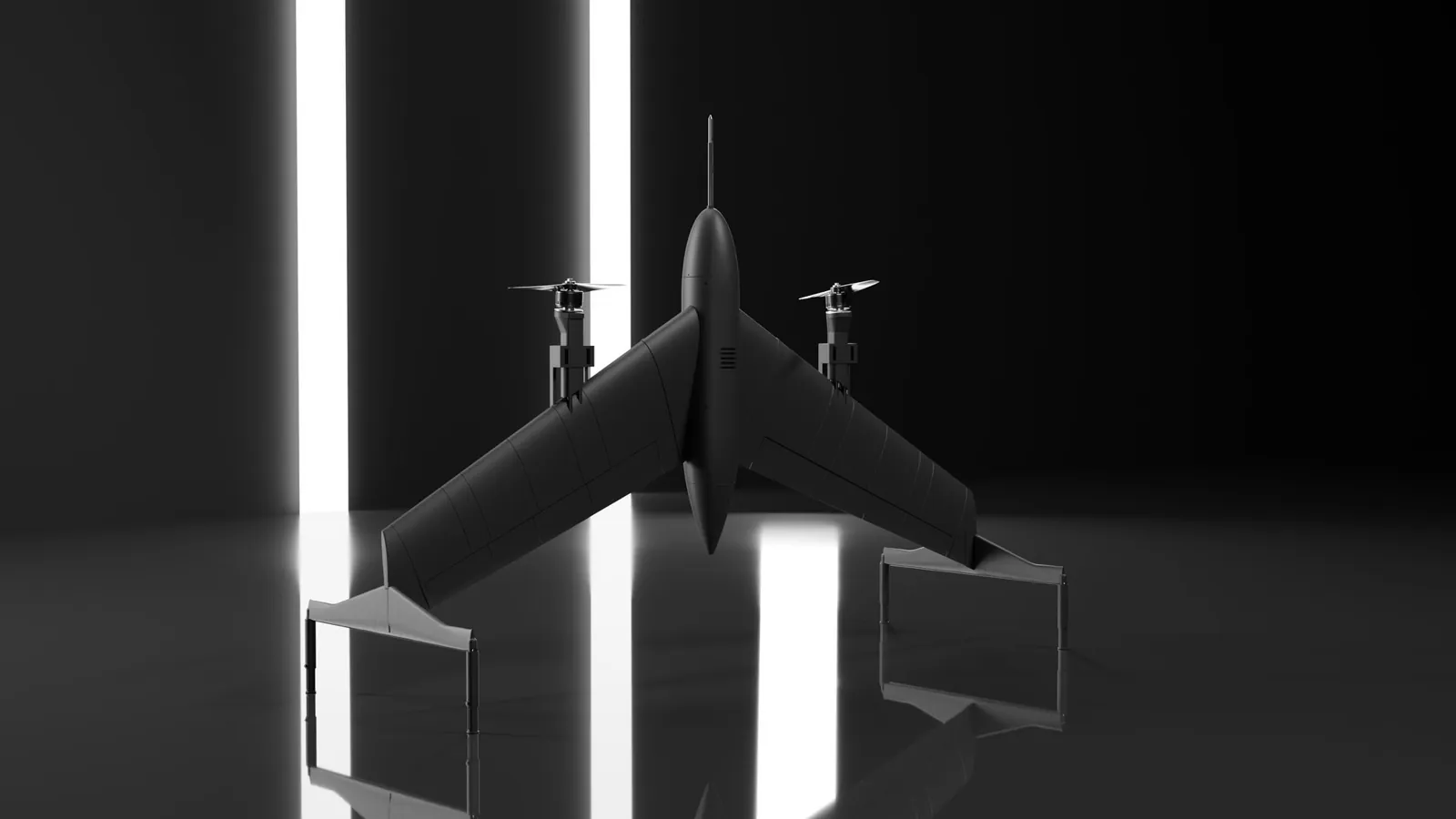
Proteus is an uncrewed vehicle that should fly and travel under water with the same airframe. It is a flying wing with two motors. It takes off standing up, tips over to fly like a plane, and lands on four feet at the wing tips.
Nothing has flown yet and nothing has been in water. Every number below comes from models, CAD or CFD, except the thrust-stand runs.
How we work
We do a lot of the modelling, CAD and code with AI agents (Claude Code, plus other models as reviewers). The work for us, the team, is deciding what to build and checking whether the results are true: reading the outputs, recomputing numbers in a separate script, running a known test case first, printing the part, measuring it. A lot of what's below is about where that checking caught something.
Where checking caught something
- I read the first results myself and found penalties counted twice and a missing trim calculation.
- A second CAD kernel found 227 overlaps that our first check called one.
- Printing a wing segment found an unbonded spar ring that the software check had passed.
- A bump in the geometry files faked flow separation and voided three CFD blocks.
- After round three, the review loop only churned. Blind reviewers scored lower than reviewers who had seen their own previous reports.
- Our prop model passed on thrust but failed on torque and current. That is why we built a thrust stand.
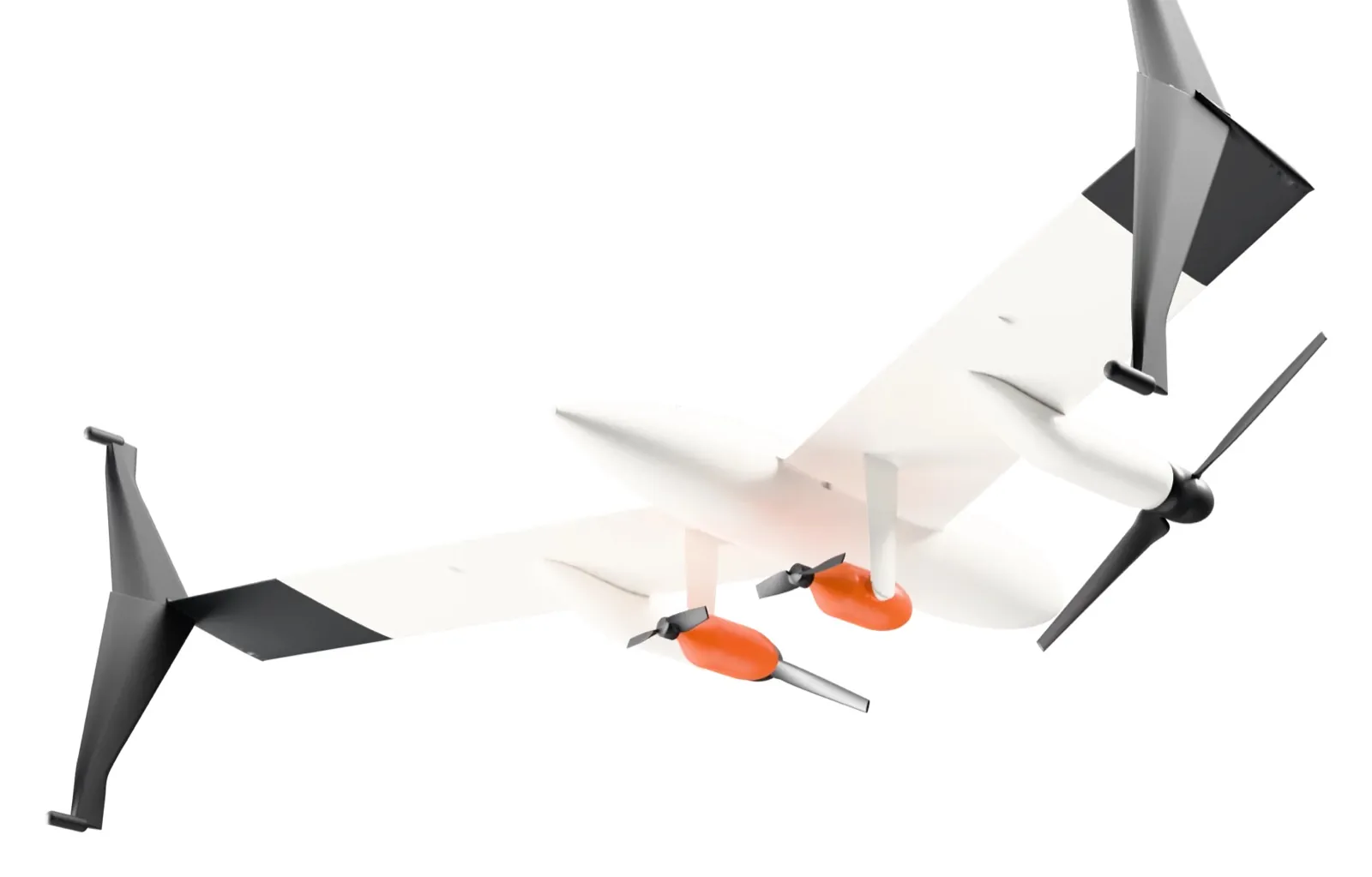
P7R from below
What I do
I co-lead the project with Davide; either of us can make a decision. Right now I'm working on the electronics and test rigs: the thrust stand, its sensors and firmware, the current sensor that still reads wrong, and the removable wing joint. Before that I worked on the wing redesign, the CFD runs, the fix package for P8N, and the positioning layers.
What's next
Measure the motors and props on the stand, finish the build, first flight. Water comes after that.
Work log · 32 steps
-
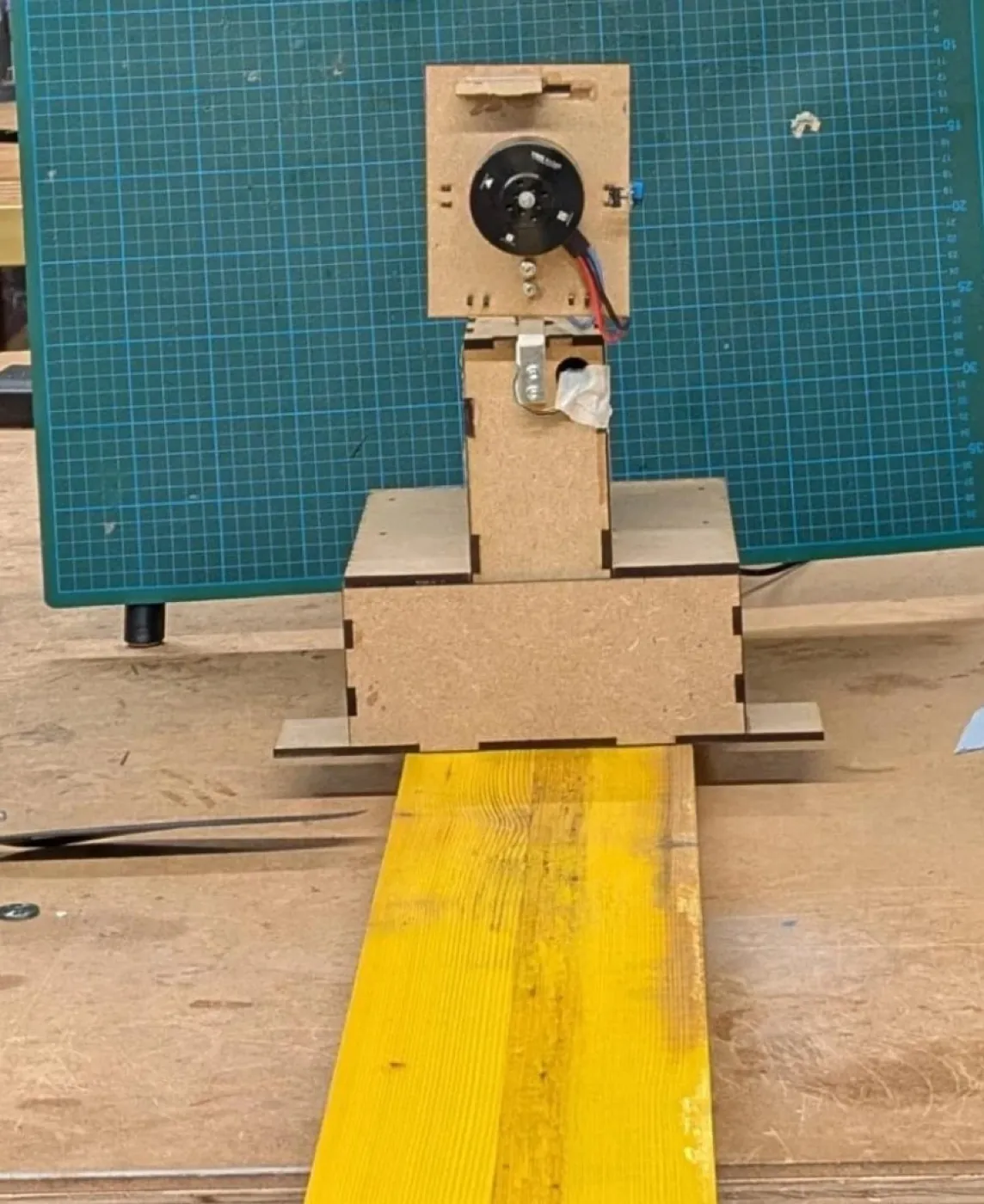
First props-on runs
Low-throttle runs at 6S with the P8N motor and prop.
Learned: +12 to +76 g at 1100–1250 µs. The prop for the other spin direction gave negative thrust.
-
Mission platform and a navigation network
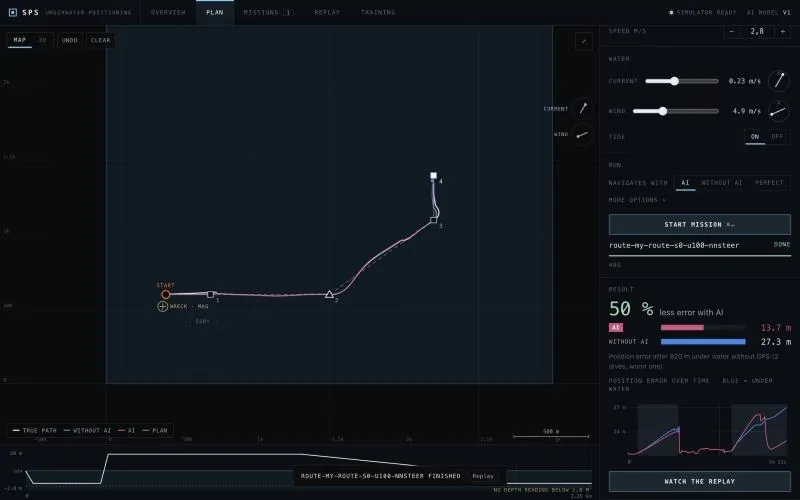
Martin Behrmann turned the simulator into an app to plan, run and replay missions, trained a small network that estimates speed through the water, and added waves and tailsitter transitions.
Learned: On open routes the network cut the median final error from 43 m to 29 m. With 0.4 m waves the 10 cm GPS mast is awash almost all the time, so the antenna has to go higher.
-
Thrust stand electronics and firmware
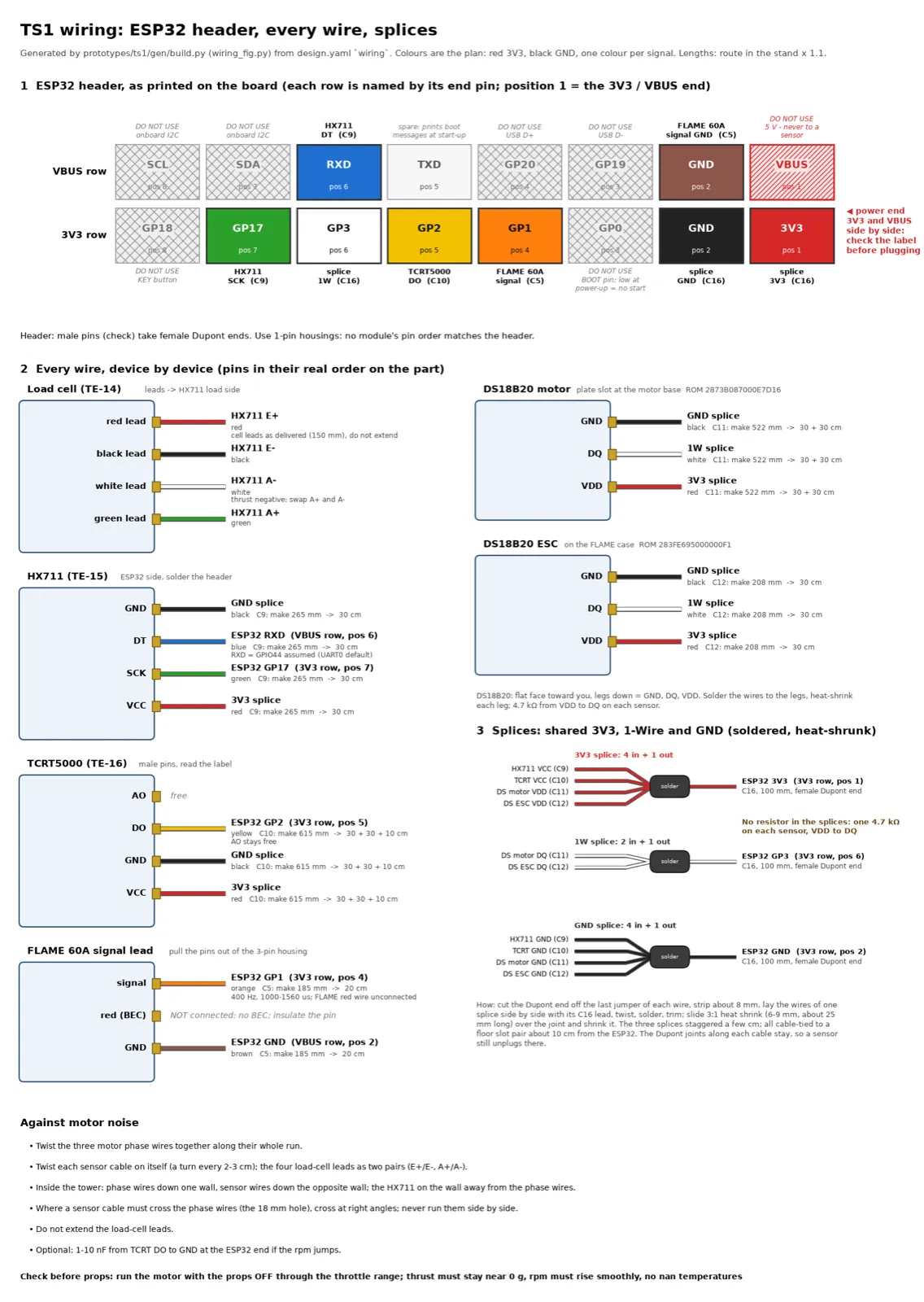
ESP32-S3 firmware with watchdog and ramp, a dashboard, calibration tools, soldering, a second temperature bus.
Learned: The motor signal silently failed because we only checked the commanded value, not the pin. The rpm sensor double-counted until we timed quiet gaps. The current reading still sticks at 0.5 A.
-
A world model for diving without GPS
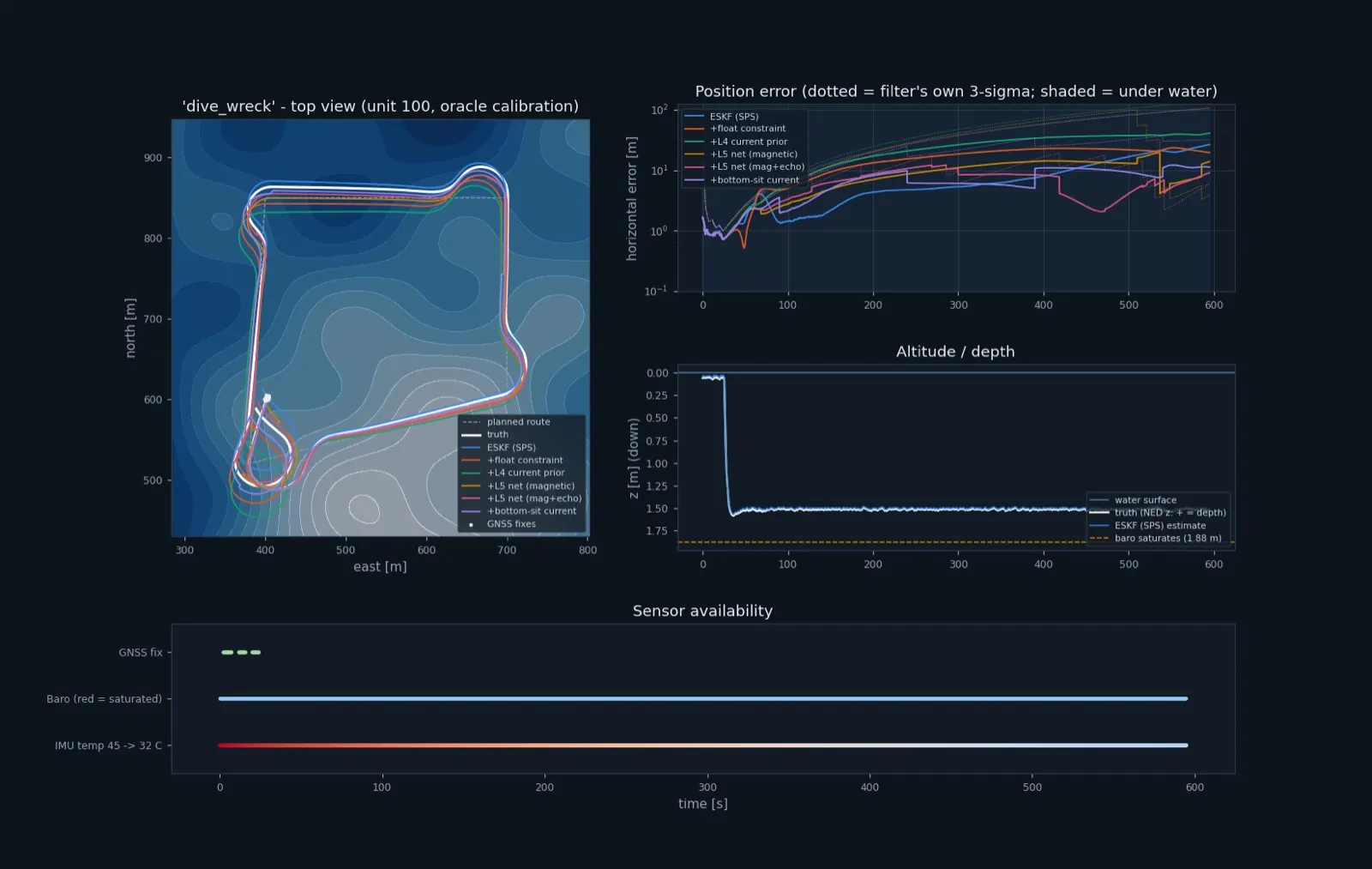
Davide's simulator flies P8N with its real sensors, dives, and loses GPS. I built learning and map layers on top.
Learned: Most error came from the current picked up while floating. One physics constraint fixed most of it; final error on held-out dives fell from 38 m to under 7 m (simulation).
-
Thrust stand, designed, cut and built
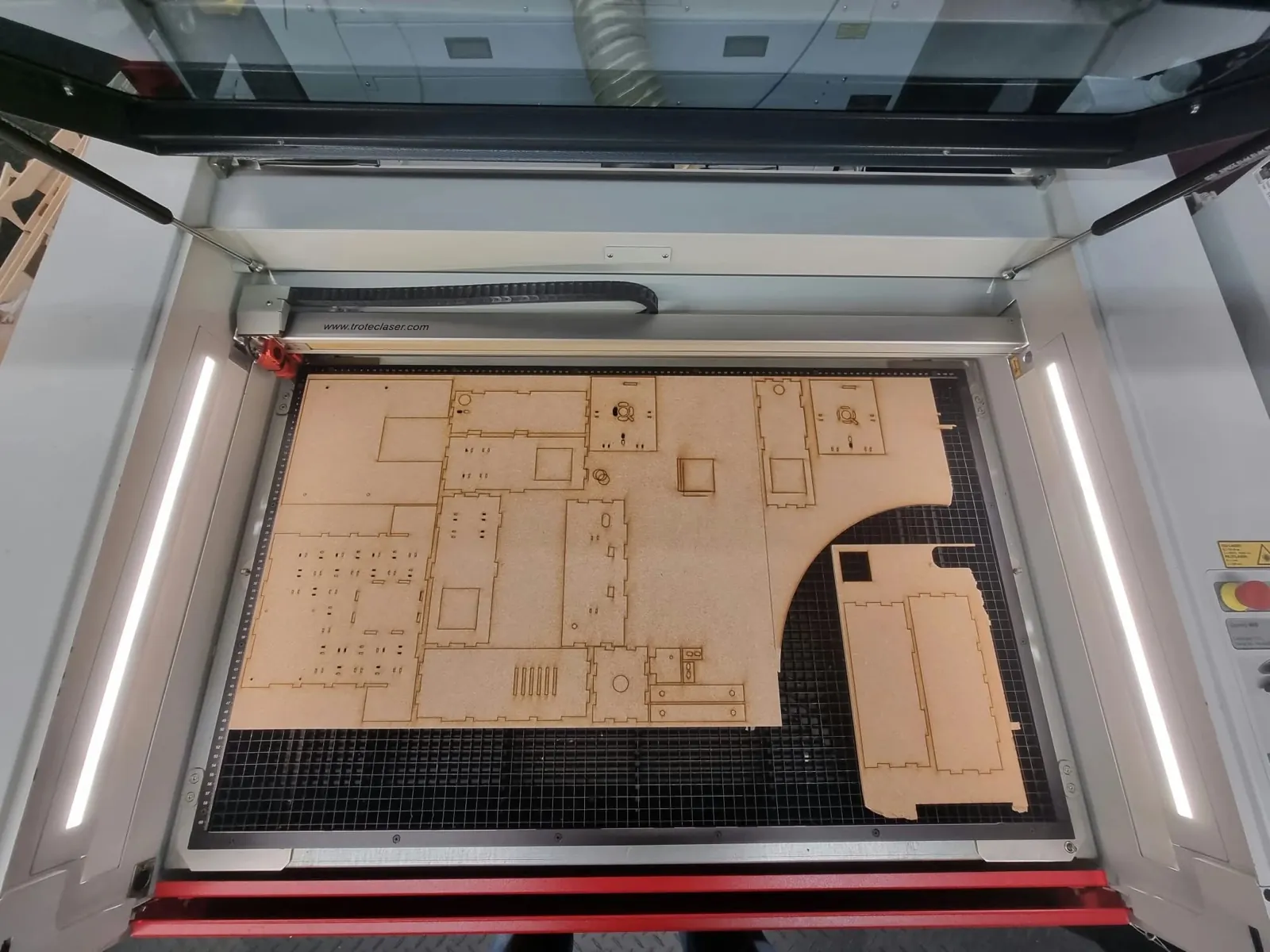
18 MDF parts generated with a STEP model and clash checks, a single load path through a 20 kg load cell. Davide and I laser-cut, recut and assembled it ourselves.
Learned: A test cut showed 4.0 mm slots fit best, so the clearance went to zero.
-
An independent review
A blind review with its own calculations and 26 ranked findings.
Learned: The concept is right, but every key margin (0–10 %) is smaller than its uncertainty (5–20 %). The better P8N is not a better drawing, it is this one with measured numbers.
-
Every sensor against its datasheet
Each P8N sensor checked against the maker's own document or the ArduPilot source.
Learned: Our 60 A ESC is 30 A continuous in its manual, and hover needs about 29 A. The airspeed sensor reads 11 % high at the default ratio.
-
Fix package, re-checked
An outside fix list (strut, feet, elevon coupling, spar sleeve), an elevon build sheet, then a re-check against the new repo.
Learned: Three of four fixes were already done in the new repo. The rear-rod seat stayed the main open item.
-
Neutral point, ballast, props
Two Euler cases with an independent recompute. Fixed counter-rotating props for air tests, two servos instead of four.
Learned: CFD put the neutral point 0.3 mm from the estimate. A recompute showed trim moves 0.7° per mm of CG offset, not 2.8°.
-
New repo, facts as data
Moved to a new repo with decisions as files, one file per purchased part, and documents generated from data.
Learned: The old repo said the same thing in 84 places. Re-running P8N in the new repo gave 195 of 195 meshes byte-identical, and found one stale result.
-
Six review rounds, then a stop
Fix agents plus six read-only reviewers per round.
Learned: Rounds 1–3 caught crash-level faults (no rpm cap, swapped motor outputs, a mode that bypassed the throttle limit). Rounds 4–6 only churned, and blind reviewers scored 0.9 lower. We stopped and reviewed by hand.
-
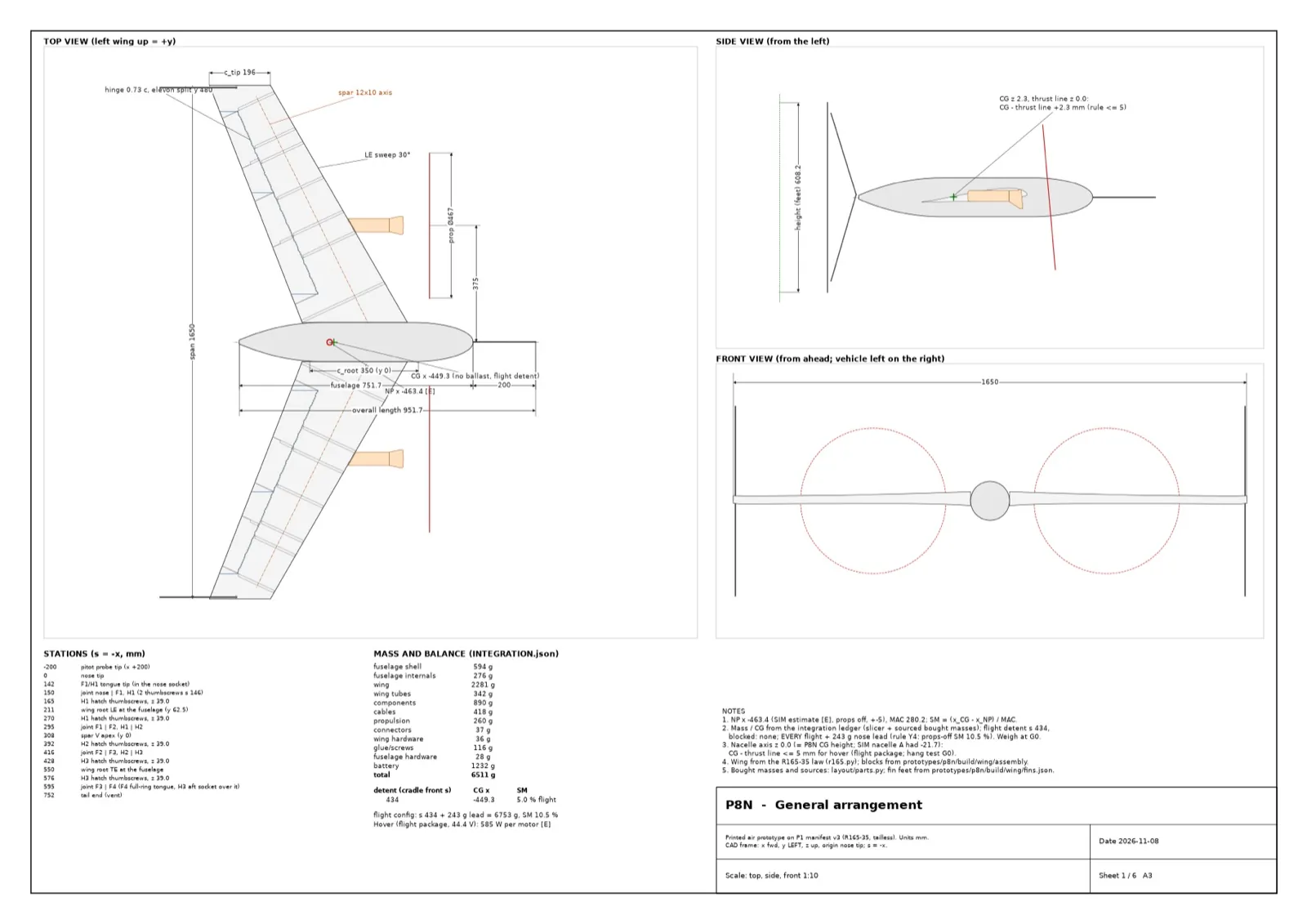
P8N, generated from data
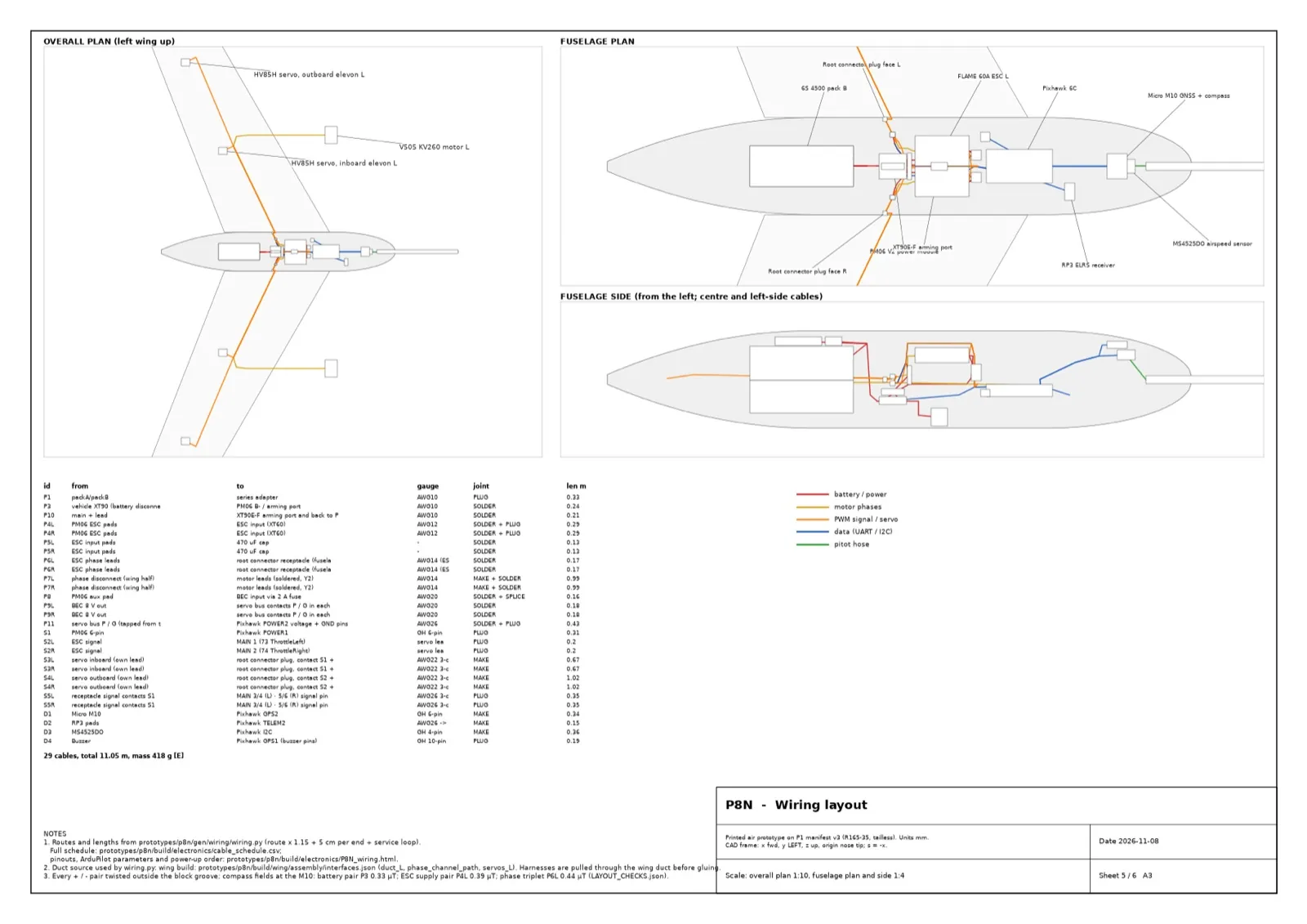
Mass ledger, wing and fuselage, wiring, drawings, a 3D viewer, the build checklist and the autopilot parameters, all generated from one design file.
Learned: Slicer masses said each wing half weighs 1026 g, not 690 g. P8N went from 6.15 to 6.75 kg.
-
The tailless wing, checked
A tailless wing with split elevons. Criteria frozen, then props-on and stall CFD.
Learned: The split flap gave twice the lift of the first estimate. Three independent neutral-point numbers agreed within 0.6 mm.
-
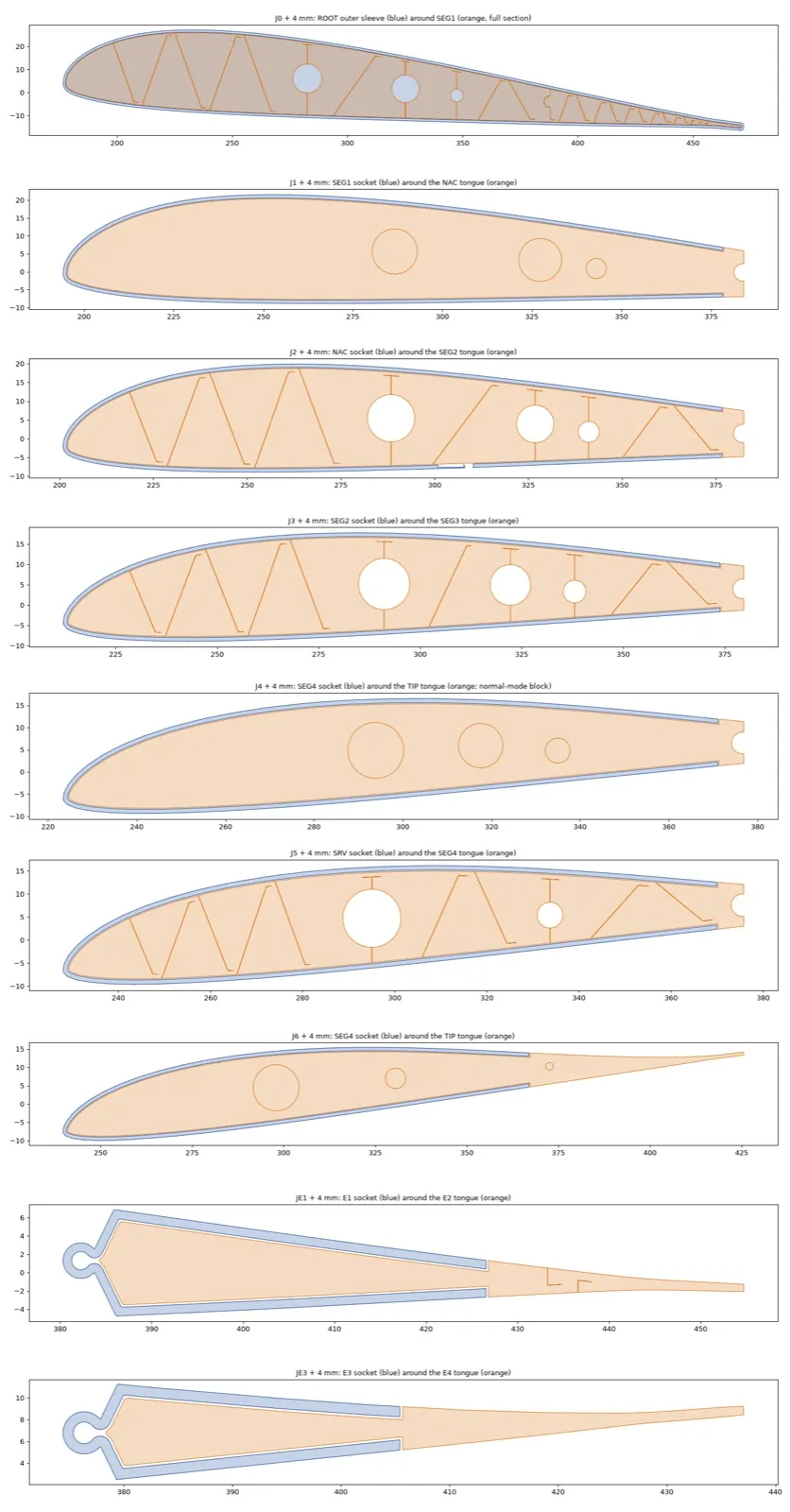
Nine wing test prints
A 60 mm wing section printed in PETG on a Prusa MK4S, v1 to v9, then full-wing sets and joint tests.
Learned: v1–v5 failed with unconnected walls. v6 (solid body with 0.02 mm slits, vase mode, truss inside) worked. Printing a segment showed an unbonded spar ring that our software check missed; a new check then found 456 weak spots. A check counts only after it has caught a known-bad print.
-
Outside concepts and a 192-core CFD node
Screened concepts from Codex, optimised five families, cross-checked an AWS node against Euler (lift within 0.3 %).
Learned: The all-PETG wing failed on mass, buoyancy and structure. Hover wind limit improved from 2/0/0 to 4/4/2 m/s.
-
Fly in air first
Proposed building an air-only vehicle with the same shape to calibrate our models. Four reviewers approved it with conditions.
Learned: The fastest way to trust a simulation is one real flight.
-
Landing feet
Passive feet with a 1-DOF drop model, from foam blocks to a TPU lattice.
Learned: An undamped foot bottoms out at 1.2 m/s. Damping became a requirement.
-
A bump in the geometry voided three CFD blocks
Davide ran CFD blocks on a second Euler account, cross-checked against mine.
Learned: The part files carried a piece of the old wing skin, a 4–14 mm bump that faked flow separation. We threw those runs away and added a shell check.
-
New wing, and the lift we didn't have
Wings W4 / W4b with more twist; a high-lift search; three research reports on CFD validation, tailless high lift and mass.
Learned: We withdrew our planning lift coefficient of 1.0. Literature for small swept flying wings says 0.7 ± 0.1, and our best clean value was 0.64–0.67.
-
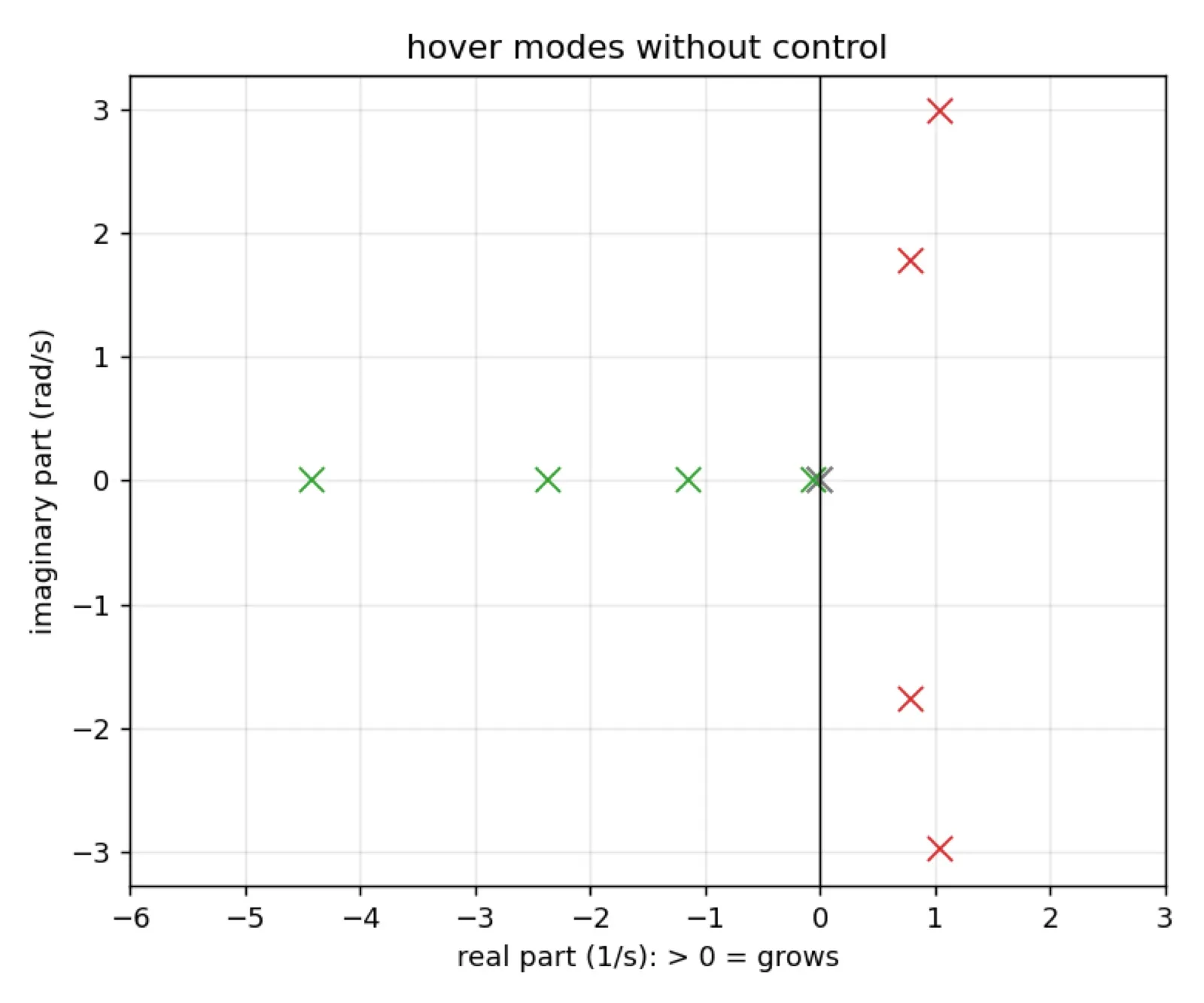
Hover and cruise campaign for P7R
6-DOF hover with a 400 Hz controller, hover CFD, cruise CFD.
Learned: Hover works but tips over in 5 m/s side wind. Cruise needed more lift than the wing gives with attached flow.
-
Letting other models attack the design
Reviews by an outside model, a four-reviewer protocol, a Gemma cross-check, a multi-agent audit and a GPT review (28 findings, 8 blockers).
Learned: Every finding was checked against the repo. Some were wrong (a buoyancy error came from stale input), most were real. Verdict: fly over land, don't dive yet.
-
CFD on the ETH Euler cluster
OpenFOAM in containers, pass criteria written before each run, and validation cases from the literature.
Learned: NACA 0012 within 1–4 %, cluster and laptop identical to four digits. A blind test of our prop model passed on thrust but failed on torque (19 %) and current (22 %), so we needed a thrust stand.
-
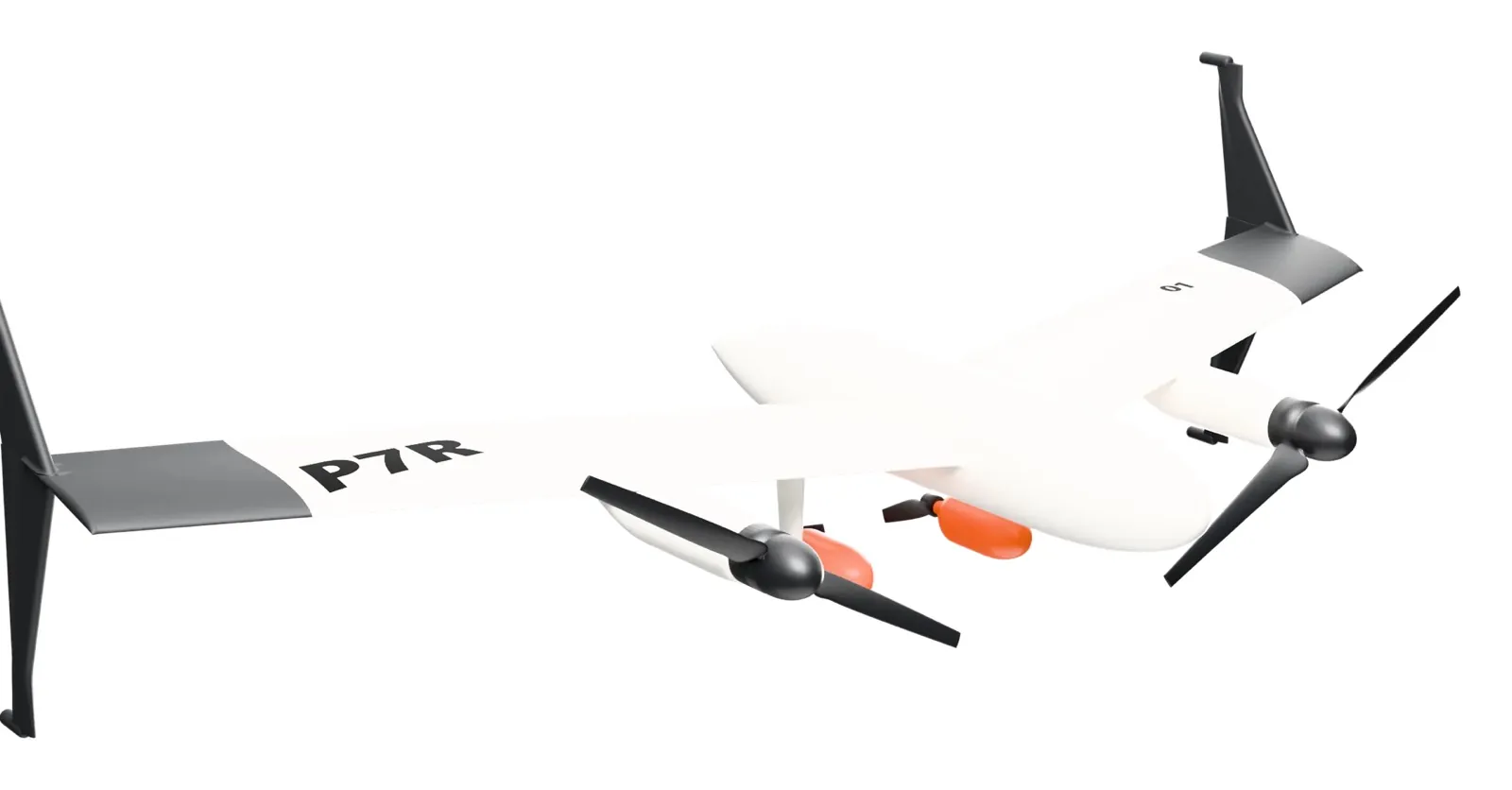
P7R, clean sheet, v1.0 released
Redesigned from scratch "so that errors are found". Native Fusion CAD of every real part, 459 bodies, an acceptance gate of 28 checks.
Learned: The simulation loader mirrored the CAD frame. It now refuses to run on any mismatch.
-
Back to two motors, and a second CAD kernel
Fusion added as an independent check, with pass thresholds written down before the first run.
Learned: Fusion found 227 overlaps where our sampling check had found one, and a model bug sized every water prop at 110 mm instead of 80. We started over.
-
P6, three motors and frozen requirements
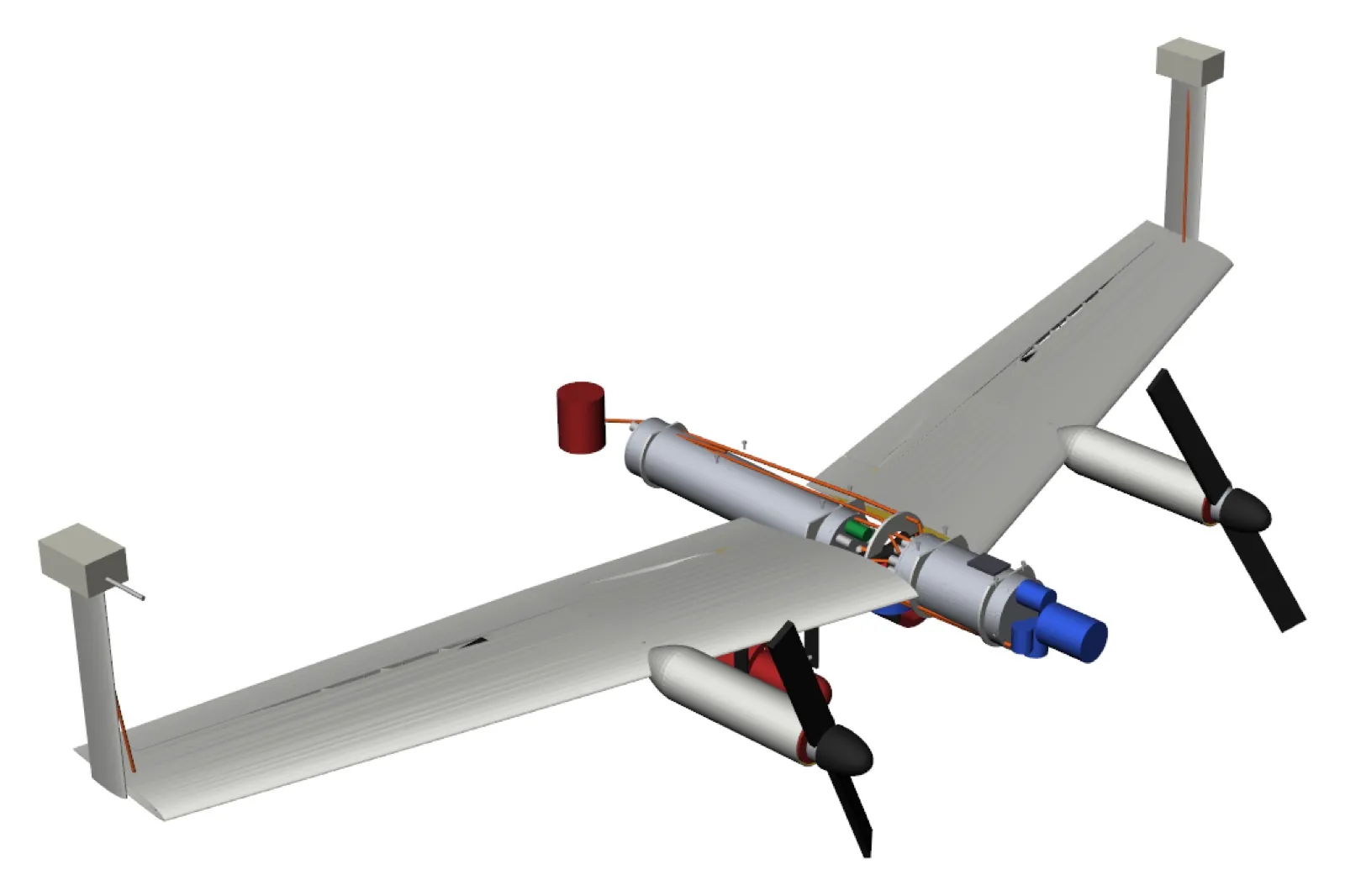
Requirements R1–R22 frozen; every motor inside its maker's range; tip fins as landing legs. 9.9 kg.
Learned: Weight optimisation moved only 50 g. The mass is in the components, not the structure.
-
P5 / P5b, the first full vehicle
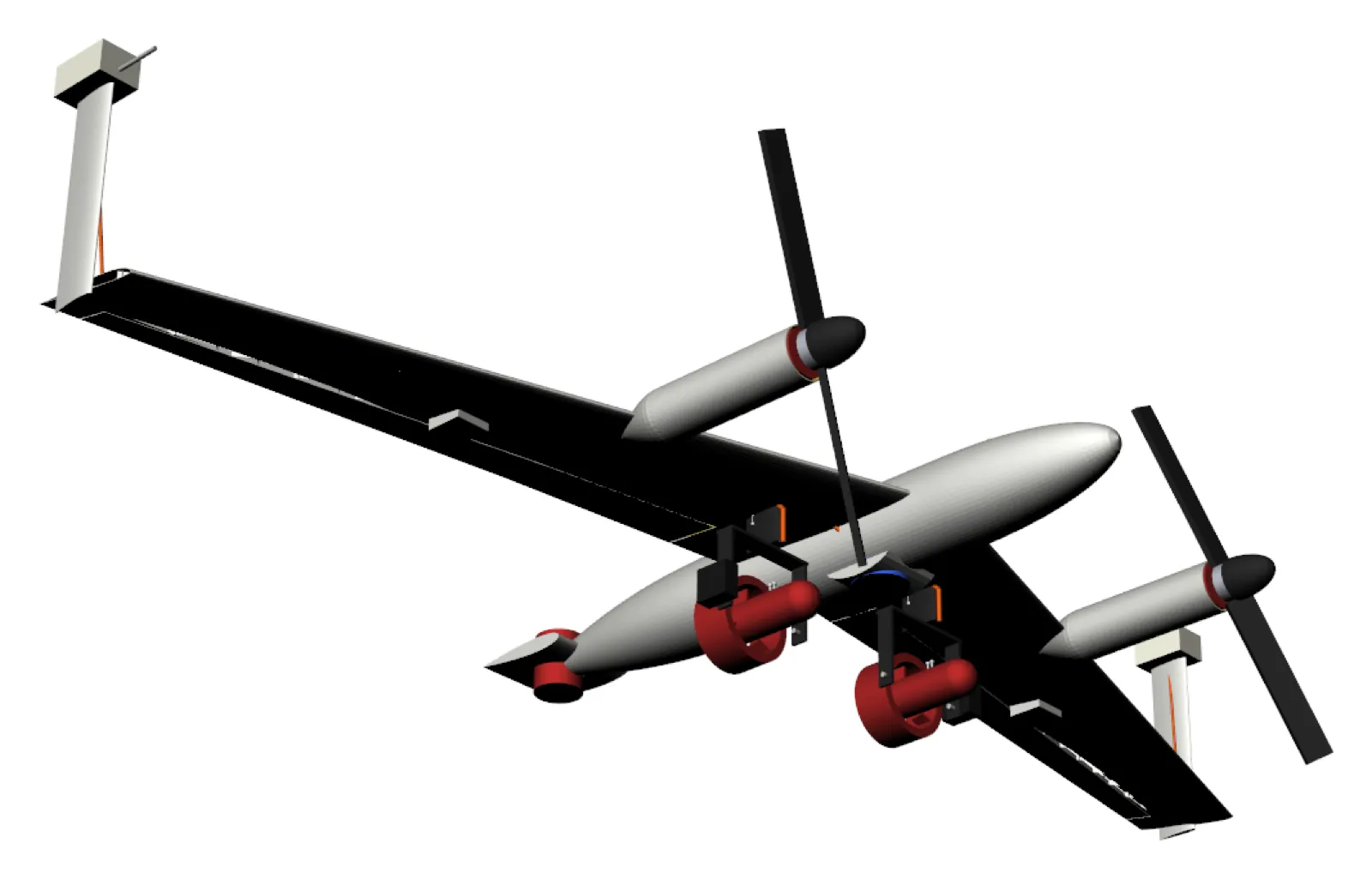
Two air motors, two T200 water thrusters, a pitch thruster. 8.6 kg.
Learned: A review found the battery sags below the converter's cut-out during water exit. A skin check found parts up to 8 mm outside the wing, hidden by an old allow-list.
-
Making it printable (layouts A3–A9)
Detailed CAD with real parts, an underwater layout study, a landing-gear study with 101 variants.
Learned: Real parts show what point masses hide. The battery could not reach its stop, the spar hit the dry box, and a water prop turned inside the wing.
-
First status report
A 16-page report on why FW2 won, how to print it, and what the first detailed CAD broke.
Learned: Reading the agent's results myself found real model errors (penalties counted twice, a missing trim calculation). From here, measuring beats more computing.
-
Optimising eight families, and hunting bugs
One parametric builder, a 6-DOF model, NSGA-II with 23–27 variables and 200 paired Monte Carlo draws per family.
Learned: Anything computed but not constrained gets exploited: both props spinning the same way, NaN counted as zero violation, designs hanging 59–86° nose-down under water. The winner (FW2) came first under all 13 weightings.
-
25 million concepts, one funnel
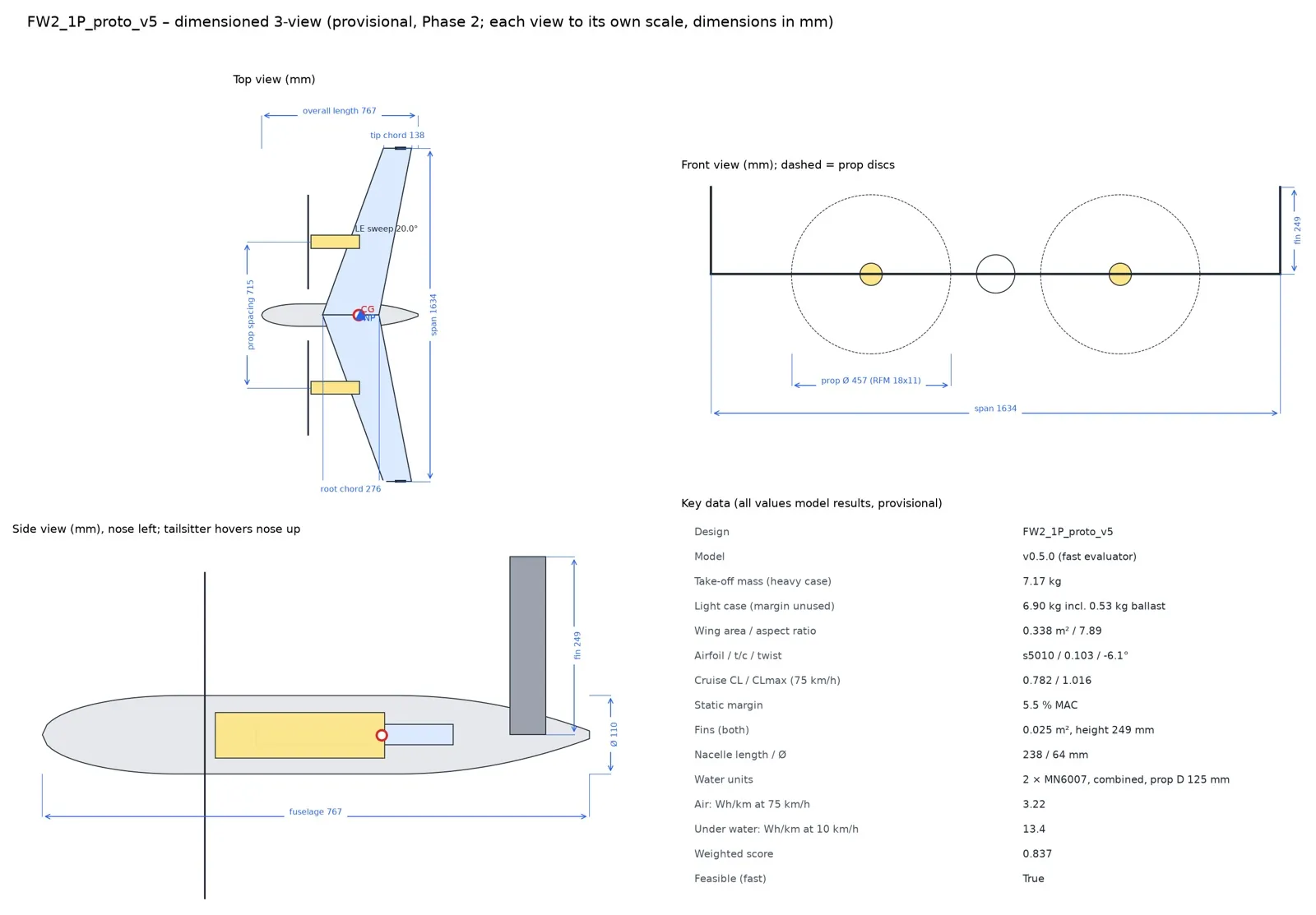
Ten sub-functions, every combination (25.4 M), about 1.7 M scored, 22,987 feasible, 265 assessed by hand-style one-pagers, 8 families kept.
Learned: Most concepts died on hover thrust reserve. The flying-wing tailsitter led by only 0.01, so we ranked on the median and never killed anything just for being uncertain.
-
Checking the fast models first
Before using any quick model to choose a design, each one had to reproduce a known result.
Learned: Hull drag matched the DARPA SUBOFF data to 0.3 %, the motor model matched the maker's bench data to 3–4 %. The weakest models became the first bench tests.
-
SolidWorks from the Mac
A job-folder bridge so Claude Code on my Mac could drive SolidWorks on a Windows laptop over SSH (import, mass properties, screenshots).
Learned: Automating a desktop CAD program from outside breaks easily. A week later we replaced SolidWorks with Fusion.